E N L I G H T E N – What is a Frame Handle Knife?
Years ago, while attending the Arkansas Custom Knife Show, Les was talking with ABS Master Smith, J.R. Cook. He pointed out what he thought was a full-tang hunter on Cook’s table. J.R. laughed and said, “This is a Frame Handle Knife.” He explained a Frame Handle Knife consists of 5 parts: the blade, the guard, the frame, and the scales. The blade slides into the frame, giving the knife the look of a full tang knife. This type of knife requires more precision and time to build than a standard hidden tang knife. Also, not every maker has the skill set needed to build one of these knives. After seeing the first one on JR’s table, Les has always found this sturdy knife construction method intriguing.

Frame Handle Knife before assembly
This photo shows the inner workings of a Frame Handle Knife before assembly. The craftsman inserts the blade tang through the guard and into the frame. Craftsman pins guard into frame.
All components are then dipped into Ferric Chloride to bring out the pattern of the Damascus. After which, the scales for the handle are attached. As you can see, the construction of this knife is more complex than a standard full or hidden tang knife. It also takes longer to build, which explains the additional cost.
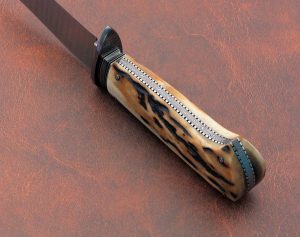
Mike Ruth, Jr. Frame Handle Forged Damascus Drop Point Hunting Knife with Sambar Stag & File Work
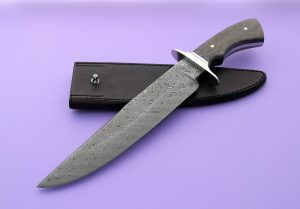
Mike Ruth Sr. Forged Damascus Bowie Knife unique Mastodon Ivory handle
Damascus Frame-Handle Hunters: Details Matter
Frame-handle construction is one of the most technically demanding methods for building a custom knife. Unlike a full-tang knife, where the tang forms the handle’s outline, or a traditional hidden-tang knife, a frame-handle knife uses a separate metal frame surrounding the hidden tang. The result creates the appearance of an exposed tang while giving the maker considerably greater freedom in design and material selection.
A frame-handle knife typically incorporates five essential elements: the tang, guard, frame, handle scales, and pins. Some makers add spacers, a threaded tang, and a locking nut for greater alignment and strength. Every component must fit precisely, making this construction a revealing test of a maker’s skill.
The Damascus frame gives these hunters their unmistakable visual appeal. It also reinforces the handle and may help stabilize natural materials as humidity changes. When an accomplished maker executes it, the transitions between the guard, frame, spacers, and handle material can appear virtually seamless.
That complexity comes with trade-offs. Frame-handle knives generally cost more because of the additional materials, labor, and precision involved. They may also weigh more, and imperfect construction can produce gaps or uneven transitions. Collectors should examine these details when evaluating one.
For collectors, however, a Damascus frame-handle hunter can occupy an especially attractive position in the custom-knife market. It retains the practical proportions and ergonomics of a hunting knife while approaching the artistry and visual presence of a museum-quality Damascus Bowie—often at a more attainable price. With seemingly limitless combinations of blade steel, Damascus patterns, guard materials, and handle materials, each frame-handle hunter can become a distinctive expression of its maker’s abilities. For collectors who understand the construction and appreciate the details, these knives may represent one of the most compelling values in forged custom cutlery.
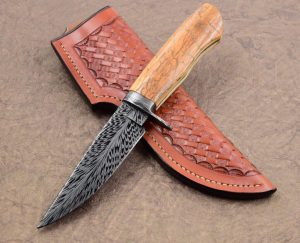
Steve Randall Custom Forged Damascus Frame Handle Hunter with Mastodon Ivory
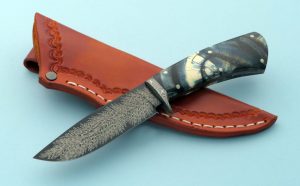
Dan Lewis Custom Forged Damascus Frame Handle Hunter
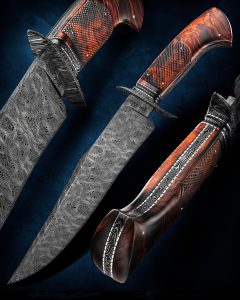
Josh Fisher Custom Forged Damascus Frame Handle Bowie
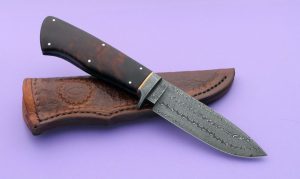
Bob Earhart Forged Damascus Frame Handle Hunter
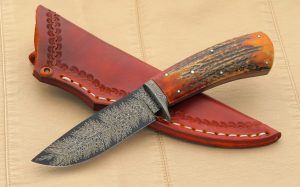
Dan Lewis Custom Forged Damascus Frame Handle Hunting Knife with Stag