• Custom knife expert for 40 years
  • Exclusive designs & limited editions
  • Personal customer service
  • Offering custom knives from some of
    the best custom knife makers in the world
27
SEP
2025

Daggers: History, Design and Modern Collectability

The Timeless Appeal of Daggers

From ancient battlefields to modern collector showcases, the dagger has remained one of the most iconic and functional edged weapons in history. Designed for precision thrusting and close-quarters defense, daggers have evolved across centuries while maintaining their defining traits—symmetrical double-edged blades, a focus on piercing capability, and compact, easily carried designs. Whether forged from bone, brass, or high-performance modern steels, daggers have always served as both tools of survival and symbols of status. View our RCC YouTube Video on the Spektra Daggers.
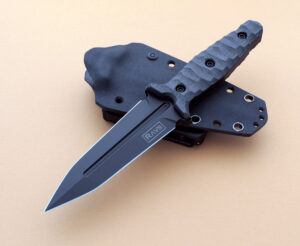
Kolakowski Spektra Tactical Custom Dagger Black Published in Blade Magazine cover and in Knives 2026 Annual

Kolakowski Spektra Tactical Dagger

Origins and Early Use of Daggers  

The exact origin of the word dagger remains a mystery, though it is believed to stem from the old French word, “daque” or the old Italian, “daga.” By the 14th century, the term was widely used to distinguish these short thrusting weapons from swords.

In medieval Europe, daggers were not just battlefield tools—they were also markers of wealth and prestige. Aristocrats carried ornate daggers with decorative sheaths, while commoners often crafted functional versions from bone or antler when metal was unavailable.

Daggers in American Self-Defense

In 19th-century America, the Bowie knife dominated as a multi-purpose tool and weapon during frontier settlement. But as cities grew and large knives became socially unacceptable in public, smaller, concealable weapons like daggers and pocket pistols replaced them. Daggers offered effective close-quarters defense, though their short range eventually gave way to the revolver as the preferred personal defense weapon.

Close-Quarters Combat (CQC) and Military Daggers

World War II: The Fairbairn-Sykes Fighting Knife No WWII dagger carries more legend than the Fairbairn-Sykes (FS) fighting knife, designed by British officers William Fairbairn and Eric Sykes. Slim, double-edged, and needle-pointed, it was ideal for stealthy thrusts in commando operations. Produced in three distinct patterns between 1940 and 1943, the FS dagger remains a benchmark in military knife design. Watch our RCC YouTube Video on Tactical Daggers.

Notable modern reproductions include:

-Brent Sandow: Pattern Two FS with D-2 steel blade, stainless guard, scalloped handle, and tactical Gunkote finish.

– Piotr Gosciniak: Stealth Dagger, fuller-bladed FS with black Cerakote, laser-cut G-10 grip, and scalloped guard for improved indexing and control. RCC YouTube Video on Gosciniak’s latest models. Stealth to Skinner
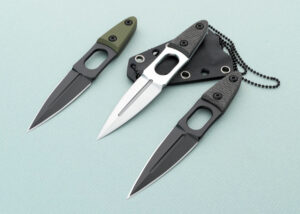
– Kolakowski Vanguard Stingers are inspired by an OSS (Office of Strategic Services) knife designed primarily for self-defense. The hole in the handle perfectly fits your thumb, giving you excellent control over the blade. The Micarta is serrated to aid in further control of the knife if it gets wet. The underside of the blade features a concave grind. Reducing weight and helping in extraction, the fuller increases the blade’s strength. Buy this Vanguard design exclusively from Robertson’s Custom Cutlery. See the Vanguard Stinger in action on YouTube.

Collector’s Lesson: Why Tang Construction Matters

In 1983, during U.S. Army Infantry Officers Basic Course training, I learned firsthand the importance of full-tang construction. I stuck a factory-made dagger—revered for its Vietnam War reputation— in a tree to tie off some 550 cord.  When I pulled the knife out of the tree, the handle was in my hand and the blade was still stuck in the tree.  This happened because its tang was only one inch long and glued in place.  Inferior construction led to a catastrophic failure.

From that day forward, I vowed to only use full-tang knives and began exclusively buying custom blades. Serious collectors and users should always verify tang construction before purchase.  Comprise elsewhere—because when your life depends on your knife, failure is not an option.

Daggers as Functional Art and Historic Icons

Daggers remain as relevant today for collectors and enthusiasts as they were for warriors centuries ago. From historical battlefield designs to innovative modern interpretations, they embody both artistry and lethal efficiency. Whether you are drawn to them for their history, craftsmanship, or combat utility; understanding the design, materials, and knifemaker behind each blade will enhance both your appreciation and your collection.  Watch our RCC YouTube Video on Tactical Daggers.

26
AUG
2020

Daggers: A Brief History

Posted By :
Comments : 0
TIM HANCOCK FRAME HANDLED FORGED ARIZONA TOOTHPICK DAMASCUS DAGGER
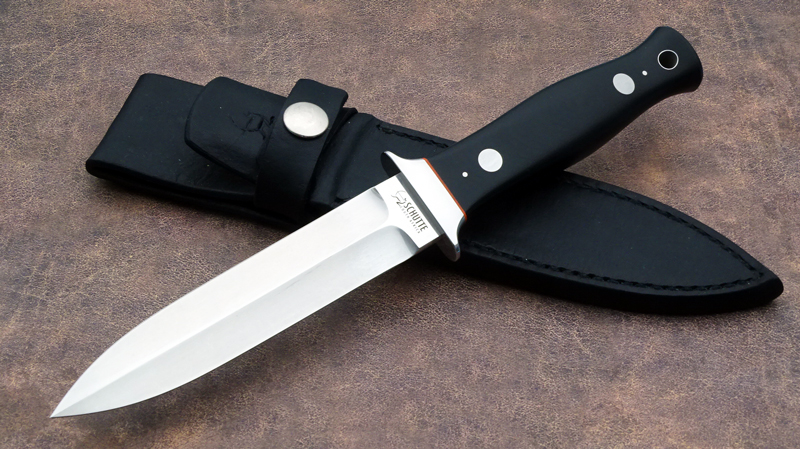
Neill Schutte Loveless Style Tactical Dagger II Custom Knife South Africa
NEILL SCHUTTE LOVELESS STYLE TACTICAL DAGGER
Neill Schutte Loveless Style Tactical Dagger II Custom Knife South Africa


NEILL SCHUTTE LOVELESS STYLE TACTICAL DAGGER II

The DAGGER, unlike the blade designs that carry the names; hunter, fighter, Bowie or even sword, daggers almost always conjure up a singular image in the mind. Primarily, a blade evenly ground on either side of a center line to a point and sharpened on both sides. Now the steel or the guard (or lack thereof) or handle may differ from knife to knife, but the blade remains the same.

My First Custom Tactical Dagger

My entry into the world of custom knives in 1984 saw the emergence of the golden age of art daggers. Buster Warenski left no doubt that he was the Master Craftsman of that era. Other makers doing exceptional work during that time included Willie Rigney, Fred Carter, and Billy Mace Imel. For those of you unfamiliar with any of the previous names I would encourage you to utilize your “Google-Fu” and search these makers and their work out. Having been a fan of the F-S Dagger, I was forced to stop at the table of Billy Imel at the Guild show in the early 1990’s. On his table was his version of the F-S dagger; beautiful, sleek and deadly. I’m sure other makers had done this before, but this is the first Fairbairn Sykes custom tactical dagger I remember seeing. 

Dagger History

ROD CHAPPEL (DAVIS KNIVES) BOOT KNIFE

Daggers have been around as long as man. Early daggers were made of flint, ivory or bone either as a stand alone blade or attached to a piece of wood. As war and its weapons evolved, daggers were made from bronze and then later from iron ore. As armor, such as steel chain mail and plate armor were resistant to slashes and cuts, the need for a weapon to penetrate was created. The dagger was the ideal weapon for this using the reverse grip. The dagger was employed in a downward technique to increase the thrust and penetrative force. As armor fell out of favor the dagger became more of a weapon of choice. During the Renaissance era the dagger became popular as a secondary weapon to the sword; then to be used in concert with a sword. During this time the dagger became part of everyday dress and they were the only weapon the common man could carry without drawing attention to himself. During this time the dagger in the form of a bayonet attached to the end of the rifle was also implemented.   

Perhaps the most familiar daggers to us were the ones that started to show up during WWI. Trench warfare demanded weapons for close-in work to be developed. Given the close quarters in the trenches, officers moved from carrying sabers/swords to wearing daggers. This trend for the officers continued after WW1 and into WW2. WW2 will be remembered for many thing; however, it may be the golden age of tactical dagger designs. Even though the Fairbairn-Sykes (F-S) and Case V-42 weren’t developed until seventy-five years later, they still captured the imagination of knife users, collectors and knife makers. 

Fuller or Blood Groove

The fuller, or as some call it, the blood groove, is an additional step to this process. As it adds both time and an additional skill set to put this into the blade. A common misnomer is that the blood groove is added to allow blood to flow from a wound allowing the blade to be more easily removed. The other misnomer is that suction is created by the entry of the knife. The blood groove allows air to be introduced to the wound allowing for easier retrieval. The actual reason for the fuller is to remove weight from the blade while maintaining the strength. The act of twisting the knife would aid in retrieval much better than any groove in the blade.   

Today’s Daggers

The custom fixed blade market is seeing a resurgence of tactical daggers. The tried and true variants of the F-S and Case V42 are making their appearance again.  

A classic design will always find those who want to either own or make a knife based on a classic design. Other makers are providing their take on one of man’s oldest blade designs. 

At first glance, the dagger blade seems to be a basic knife to grind. However, it is the symmetry of the blade that makes it very difficult to keep all four grinds symmetrical. It is the centerline from the front of the guard to the end of the tip that makes or breaks the symmetry. Failure to achieve that straight grind will eliminate the possibility of achieving that symmetry. Even for very well-known knife makers achieving the symmetry is not a given. While judging the custom knife competition at the Blade Show I have seen two knives; both with an asking price of at least $15,000.00 with a crooked centerline. Why the knife maker would knowingly let that knife out of his shop with that obvious mistake one can only guess.   

As was shown by the soldiers of WWII the dagger can and will be used for a myriad of purposes. However, the blade did not always lend itself to the job at hand. Many FS daggers were ruined as their owners broke the tips trying to open ration cans. While today most will find their way into collections. The lethality of the dagger has not changed and most will be able to accomplish the chore they were designed for all those thousands of years ago.

Interested in purchasing your own Sykes Fairbairn or tactical dagger? Place an order for one by Walter Brend here.